Japanese design agency TO-GENKYO has designed an innovative hourglass shaped label for packaged meat which uses a special ink that changes color as ammonia is released inside the package. As the meat ages, it releases increasing amounts of the substance, obscuring the barcode at the bottom. Customers can quickly see if the meat is going bad – and when the barcode becomes completely covered, it can’t be scanned.
Health Care Education [Environmental health, Physical health, Social health, Emotional health, Intellectual health, and Spiritual health] The purpose of health education is to positively influence the health behavior of individuals as well as the living and working conditions that influence their health.
Showing posts with label Safety. Show all posts
Apr 29, 2012
Ingenious Label Design Ensures Food Safety
Japanese design agency TO-GENKYO has designed an innovative hourglass shaped label for packaged meat which uses a special ink that changes color as ammonia is released inside the package. As the meat ages, it releases increasing amounts of the substance, obscuring the barcode at the bottom. Customers can quickly see if the meat is going bad – and when the barcode becomes completely covered, it can’t be scanned.
Jan 9, 2011
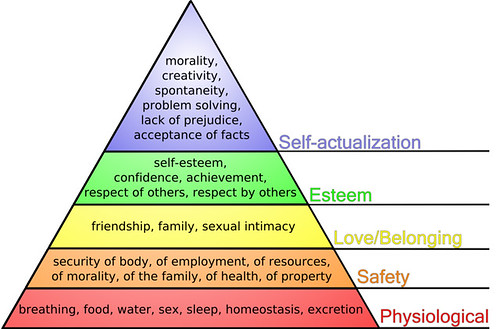
Maslow's Hierarchy of Needs
Maslow's hierarchy of needs is a theory in psychology, proposed by Abraham Maslow in his 1943 paper A Theory of Human Motivation.
Maslow subsequently extended the idea to include his observations of humans' innate curiosity. His theories parallel many other theories of human developmental psychology, all of which focus on describing the stages of growth in humans.
Maslow studied what he called exemplary people such as Albert Einstein, Jane Addams, Eleanor Roosevelt, and Frederick Douglass rather than mentally ill or neurotic people, writing that "the study of crippled, stunted, immature, and unhealthy specimens can yield only a cripple psychology and a cripple philosophy." Maslow studied the healthiest 1% of the college student population.
Maslow's theory was fully expressed in his 1954 book Motivation and Personality.
Maslow subsequently extended the idea to include his observations of humans' innate curiosity. His theories parallel many other theories of human developmental psychology, all of which focus on describing the stages of growth in humans.
Maslow studied what he called exemplary people such as Albert Einstein, Jane Addams, Eleanor Roosevelt, and Frederick Douglass rather than mentally ill or neurotic people, writing that "the study of crippled, stunted, immature, and unhealthy specimens can yield only a cripple psychology and a cripple philosophy." Maslow studied the healthiest 1% of the college student population.
Maslow's theory was fully expressed in his 1954 book Motivation and Personality.
Subscribe to:
Posts (Atom)