
Feb 4, 2014
Jan 11, 2014
Winter Weather Health: HYPOTHERMIA and FROSTBITE


What is HYPOTHERMIA?
When exposed to cold temperatures, your body begins to lose heat faster than it can be produced. The result is hypothermia, or abnormally low body temperature. Body temperature that is too low affects the brain, making the victim unable to think clearly or move well. This makes hypothermia particularly dangerous because a person may not know it is happening and won't be able to do anything about it.Hypothermia occurs most commonly at very cold environmental temperatures, but can occur even at cool temperatures (above 40°F) if a person becomes chilled from rain, sweat, or submersion in cold water.
Who is most at risk for hypothermia?
Victims of hypothermia are most often:- elderly people with inadequate food, clothing, or heating
- babies sleeping in cold bedrooms
- children left unattended
- adults under the influence of alcohol
- mentally ill individuals
- people who remain outdoors for long periods—the homeless, hikers, hunters, etc.
What are the warning signs for hypothermia?
Dec 14, 2013
Hippocratic fingers (Nail clubbing)
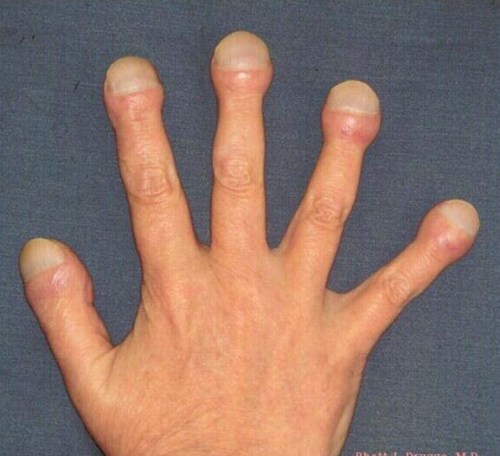
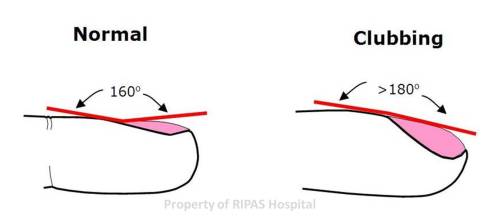
Clubbing (nail clubbing or Hippocratic fingers ) is a deformity of the fingers and fingernails, with changing of the distant finger phalanges into the form of a drumstick or fingernails into the form of a watch-glass presents a well-known clinical phenomenon that suggests the presence of various diseases, especially those associated with hypoxia, mostly of the heart and lungs.

Source:
http://www.nlm.nih.gov/medlineplus/ency/article/003282.htm
http://emedicine.medscape.com/article/1105946-overview
Aug 23, 2013
Multiple Chemical Sensitivity: a diagnosis not to be missed.
Environmental Health and Safety
Brief Overview
People in modern societies spend more than 90% of their time indoors. Hence, indoor environmental quality (IEQ) has a significant impact on public health. In this article are described health risks associated with indoor environments, illuminate barriers to overcoming these risks, and provide policy recommendations to achieve healthier indoor environments.
 Indoor environmental quality (IEQ) refers to the quality of a
building’s environment in relation to the health and well-being of those
who occupy space within it. IEQ is determined by many factors,
including lighting, air quality, and damp conditions. Workers are often
concerned that they have
symptoms or health conditions from exposures
to contaminants in the buildings where they work. One
reason for this concern is that their symptoms often get better when
they are not in the building.
While research has shown that some respiratory symptoms
and illnesses can be associated with damp buildings, it is still unclear
what measurements of indoor
contaminants show that workers are at risk for disease.
In most instances where a worker and his or her physician suspect that
the building environment
is causing a specific health condition, the information
available from medical tests and tests of the environment is not
sufficient to establish which
contaminants are responsible. Despite uncertainty about
what to measure and how to interpret what is measured, research shows
that building-related
symptoms are associated with building characteristics,
including dampness, cleanliness, and ventilation characteristics.
Indoor environmental quality (IEQ) refers to the quality of a
building’s environment in relation to the health and well-being of those
who occupy space within it. IEQ is determined by many factors,
including lighting, air quality, and damp conditions. Workers are often
concerned that they have
symptoms or health conditions from exposures
to contaminants in the buildings where they work. One
reason for this concern is that their symptoms often get better when
they are not in the building.
While research has shown that some respiratory symptoms
and illnesses can be associated with damp buildings, it is still unclear
what measurements of indoor
contaminants show that workers are at risk for disease.
In most instances where a worker and his or her physician suspect that
the building environment
is causing a specific health condition, the information
available from medical tests and tests of the environment is not
sufficient to establish which
contaminants are responsible. Despite uncertainty about
what to measure and how to interpret what is measured, research shows
that building-related
symptoms are associated with building characteristics,
including dampness, cleanliness, and ventilation characteristics.
Brief Overview
People in modern societies spend more than 90% of their time indoors. Hence, indoor environmental quality (IEQ) has a significant impact on public health. In this article are described health risks associated with indoor environments, illuminate barriers to overcoming these risks, and provide policy recommendations to achieve healthier indoor environments.
 Indoor environmental quality (IEQ) refers to the quality of a
building’s environment in relation to the health and well-being of those
who occupy space within it. IEQ is determined by many factors,
including lighting, air quality, and damp conditions. Workers are often
concerned that they have
symptoms or health conditions from exposures
to contaminants in the buildings where they work. One
reason for this concern is that their symptoms often get better when
they are not in the building.
While research has shown that some respiratory symptoms
and illnesses can be associated with damp buildings, it is still unclear
what measurements of indoor
contaminants show that workers are at risk for disease.
In most instances where a worker and his or her physician suspect that
the building environment
is causing a specific health condition, the information
available from medical tests and tests of the environment is not
sufficient to establish which
contaminants are responsible. Despite uncertainty about
what to measure and how to interpret what is measured, research shows
that building-related
symptoms are associated with building characteristics,
including dampness, cleanliness, and ventilation characteristics.
Indoor environmental quality (IEQ) refers to the quality of a
building’s environment in relation to the health and well-being of those
who occupy space within it. IEQ is determined by many factors,
including lighting, air quality, and damp conditions. Workers are often
concerned that they have
symptoms or health conditions from exposures
to contaminants in the buildings where they work. One
reason for this concern is that their symptoms often get better when
they are not in the building.
While research has shown that some respiratory symptoms
and illnesses can be associated with damp buildings, it is still unclear
what measurements of indoor
contaminants show that workers are at risk for disease.
In most instances where a worker and his or her physician suspect that
the building environment
is causing a specific health condition, the information
available from medical tests and tests of the environment is not
sufficient to establish which
contaminants are responsible. Despite uncertainty about
what to measure and how to interpret what is measured, research shows
that building-related
symptoms are associated with building characteristics,
including dampness, cleanliness, and ventilation characteristics.Aug 13, 2013
Fissured Tongue

Pathophysiology
Fissured tongue affects only the tongue and is a finding in Melkersson-Rosenthal syndrome, which consists of a triad of fissured tongue, granulomatous cheilitis, and cranial nerve VII paralysis (Bell palsy)Epidemiology
Frequency
United States: ~ 2-5% of the population.
International: 21% worldwide population.
Fissured tongue is a totally benign condition and is considered by most to be a variant of normal tongue architecture. When seen in association with Melkersson-Rosenthal syndrome, the morbidity is due not to the fissured tongue but is secondary to the granulomatous inflammation of the lips/facial soft tissues and facial paralysis.Read more :
http://emedicalhub.com/fissured-tongue/
http://emedicine.medscape.com/article/1078536-overview
Aug 7, 2013
Jun 19, 2013
Learn About Sickle Cell Disease
19 June - Sickle Cell Day
Sickle cell disease is a group of disorders that affects hemoglobin, the molecule in red blood cells that delivers oxygen to cells throughout the body. People with this disorder have atypical hemoglobin molecules called hemoglobin S, which can distort red blood cells into a sickle, or crescent, shape.
Signs and symptoms of sickle cell disease usually begin in early childhood. Characteristic features of this disorder include a low number of red blood cells (anemia), repeated infections, and periodic episodes of pain. The severity of symptoms varies from person to person. Some people have mild symptoms, while others are frequently hospitalized for more serious complications.
Links:
Facts About Sickle Cell Disease http://www.cdc.gov/ncbddd/sicklecell/facts.html
What Are the Signs and Symptoms of Sickle Cell Anemia? http://www.nhlbi.nih.gov/health/health-topics
3rd World Sickle Cell Day http://www.unesco.org/new/en/unesco/events/
Mar 21, 2013
International Day of Forests and Trees 21 March
"On this first International Day of Forests and the Tree, I urge
governments, businesses and all sectors of society to commit to reducing
deforestation, preventing forest degradation, reducing poverty and
promoting sustainable livelihoods for all forest-dependent peoples".
Secretary-General Ban Ki-moon
Message for the International Day of Forests, 21 March 2013

Forests cover one third of the Earth's land mass, performing vital functions around the world. Around 1.6 billion people - including more than 2,000 indigenous cultures - depend on forests for their livelihood.
Forests are the most biologically-diverse ecosystems on land, home to more than half of the terrestrial species of animals, plants and insects. Forests also provide shelter, jobs and security for forest-dependent populations.
They play a key role in our battle against climate change. Forests contribute to the balance of oxygen, carbon dioxide and humidity in the air. They protect watersheds, which supply fresh water to rivers.
Yet despite all of these priceless ecological, economic, social and health benefits, we are destroying the very forests we need to survive. Global deforestation continues at an alarming rate - 13 million hectares of forest are destroyed annually. Deforestation accounts for 12 to 20 percent of the global greenhouse gas emissions that contribute to global warming.
via http://www.un.org/
Secretary-General Ban Ki-moon
Message for the International Day of Forests, 21 March 2013

Forests cover one third of the Earth's land mass, performing vital functions around the world. Around 1.6 billion people - including more than 2,000 indigenous cultures - depend on forests for their livelihood.
Forests are the most biologically-diverse ecosystems on land, home to more than half of the terrestrial species of animals, plants and insects. Forests also provide shelter, jobs and security for forest-dependent populations.
They play a key role in our battle against climate change. Forests contribute to the balance of oxygen, carbon dioxide and humidity in the air. They protect watersheds, which supply fresh water to rivers.
Yet despite all of these priceless ecological, economic, social and health benefits, we are destroying the very forests we need to survive. Global deforestation continues at an alarming rate - 13 million hectares of forest are destroyed annually. Deforestation accounts for 12 to 20 percent of the global greenhouse gas emissions that contribute to global warming.
via http://www.un.org/
Mar 20, 2013
Richard St. John: Secrets of success in 8 words, 3 minutes

Why you should listen to him:
In his books and talks, he shares a wealth of wisdom from the world's most successful people -- knowledge that can help others succeed in their own way, whether it's escaping poverty, building a business, raising a family, or changing the world.
"It's so great. It's such a boost of confidence. This book really gives you a lot of self-esteem about who you are, and that you really can be somebody."-Thomas Fischer, Habitat for Humanity
Source:
http://www.ted.com/talks/
Mar 7, 2013
"Salt Sugar Fat: How the Food Giants Hooked Us " by Michael Moss

From a Pulitzer Prize–winning investigative reporter at The New York Times comes the explosive story of the rise of the processed food industry and its link to the emerging obesity epidemic. Michael Moss reveals how companies use salt, sugar, and fat to addict us and, more important, how we can fight back.
http://www.amazon.com/
http://edition.cnn.com/
Mar 4, 2013
Philips receives FDA clearance to market MicroDose SI Mammography System
Philips has announced FDA clearance of its MicroDose
SI full-field digital mammography (FFDM) system. In addition to the
capabilities of the original MicroDose approved in 2011, the company
touts the SI model’s ability to do single-shot spectroscopy, yet that
particular feature is not yet available in the U.S.
 The MicroDose device use X-ray photon-counting detectors to perform
breast tissue imaging at a considerably lower dose compared to
traditional mammography. It is hoped the technology will improve the
ability of radiologists to spot tumors within dense breast tissue.
The MicroDose device use X-ray photon-counting detectors to perform
breast tissue imaging at a considerably lower dose compared to
traditional mammography. It is hoped the technology will improve the
ability of radiologists to spot tumors within dense breast tissue.

Mar 3, 2013
1 million dollar TED prize for 'Hole In The Wall' education project
Sugata Mitra, an Indian innovator in the education
field, has been awarded the $1 million TED Prize for his bold idea in
making computer-based education more accessible to children. Mitra, an education technology professor at Newcastle University in the United Kingdom, said he will use the prize, awarded by TED, an annual global ideas conference, to launch a global initiative for self-directed learning that builds on his discovery.
 TED called Mitra’s "Hole In The Wall" project an “innovative and bold efforts towards advancing learning for children".
Mitra and his colleagues on this project dug a hole in a wall near a
Delhi slum in 1999. The team then installed a web-enabled computer and
left it there. The project’s aim was to show that children can learn
almost anything without the need for a classroom environment or a mentor
or teacher.
TED called Mitra’s "Hole In The Wall" project an “innovative and bold efforts towards advancing learning for children".
Mitra and his colleagues on this project dug a hole in a wall near a
Delhi slum in 1999. The team then installed a web-enabled computer and
left it there. The project’s aim was to show that children can learn
almost anything without the need for a classroom environment or a mentor
or teacher.

Jan 16, 2013
"Diabulimia" in Type 1 Diabetes
According to the National Eating Disorders Association, eating disorders
— such as anorexia, bulimia and binge eating disorder — include extreme
emotions, attitudes and behaviors surrounding weight and food issues.
Eating disorders are serious emotional and physical problems that can
have life-threatening consequences for females and males.
 Eating disorders in type 1 diabetes such as "diabulimia," as it
is known in the popular press, represent some of the most complex
patient problems—both medically and psychologically.
Eating disorders in type 1 diabetes such as "diabulimia," as it
is known in the popular press, represent some of the most complex
patient problems—both medically and psychologically.
Women with eating disorders and diabetes typically struggle with symptoms similar to those of women with eating disorders who do not have diabetes. However, they exhibit a very dangerous symptom of calorie purging in the form of insulin restriction.
This condition is characterized by weight and body image concerns that lead to the mismanagement of diabetes.
The NHS National Diabetes Audit says a high proportion of women aged between 15 and 30 are skipping insulin injections to lose weight. Now a charity wants diabulimia, as it is known, officially recognised as a mental health condition.
"Between 1 April 2010 and 31 March 2011, 8,472 people included in the NDA [national diabetes audit] were admitted to hospital in the UK for diabetic ketoacidosis."
Women with type 1 diabetes are more than twice as likely to develop an eating disorder than age-matched women without diabetes.

Women with eating disorders and diabetes typically struggle with symptoms similar to those of women with eating disorders who do not have diabetes. However, they exhibit a very dangerous symptom of calorie purging in the form of insulin restriction.
This condition is characterized by weight and body image concerns that lead to the mismanagement of diabetes.
The NHS National Diabetes Audit says a high proportion of women aged between 15 and 30 are skipping insulin injections to lose weight. Now a charity wants diabulimia, as it is known, officially recognised as a mental health condition.
"Between 1 April 2010 and 31 March 2011, 8,472 people included in the NDA [national diabetes audit] were admitted to hospital in the UK for diabetic ketoacidosis."
Nov 20, 2012
Neurological Disorders: Alien Hand Syndrome
Synonyms:
Anarchic hand; Diagnostic dyspraxia; Intermanual conflict; Magnetic apraxia; Unilateral apraxia; La main etrangere.
Overview
Alien hand syndrome is a rare neurological disorder that causes hand movement without the person being aware of what is happening or having control over the action. The afflicted person may sometimes reach for objects and manipulate them without wanting to do so, even to the point of having to use the healthy hand to restrain the alien hand. A new study identified the areas of the brain involved in both voluntary and involuntary movement and found that neural activity was restricted to the primary motor cortex during the unconscious motor activity seen with AHS. The study will be published online in the official journal of the American Neurological Association.
Anarchic hand; Diagnostic dyspraxia; Intermanual conflict; Magnetic apraxia; Unilateral apraxia; La main etrangere.
Overview
Alien hand syndrome is a rare neurological disorder that causes hand movement without the person being aware of what is happening or having control over the action. The afflicted person may sometimes reach for objects and manipulate them without wanting to do so, even to the point of having to use the healthy hand to restrain the alien hand. A new study identified the areas of the brain involved in both voluntary and involuntary movement and found that neural activity was restricted to the primary motor cortex during the unconscious motor activity seen with AHS. The study will be published online in the official journal of the American Neurological Association.
Nov 7, 2012
The Perfect Defect: A Chinese Boy with Cat-Like Eyes Can See in the Dark
Nong Youhui is a young boy from Southern China who was born
with Siamese bright blue eyes that allow him to see in pitch dark.

An eye-specialist visited the boy, in his home village, in China’s Guanxi province, to examine his unusual eyes, the first thing he noticed when he arrived was that Nong’s eyes were light blue just like Westerners, but very unusual for Asians. He became even more intrigued when he noticed that when shined upon with a flashlight, the boy’s eyes would emit a kind of blue-green light, just like a cat’s. As it turned out, his eyes not only looked liked a feline’s they also allowed him to see and even read perfectly in total darkness.

An eye-specialist visited the boy, in his home village, in China’s Guanxi province, to examine his unusual eyes, the first thing he noticed when he arrived was that Nong’s eyes were light blue just like Westerners, but very unusual for Asians. He became even more intrigued when he noticed that when shined upon with a flashlight, the boy’s eyes would emit a kind of blue-green light, just like a cat’s. As it turned out, his eyes not only looked liked a feline’s they also allowed him to see and even read perfectly in total darkness.
Sep 29, 2012
World Heart Day 2012 : Focus on Women and Children


This year our efforts will focus on protecting the hearts of women and children through heart-healthy actions.
This year, World Heart Day is even more significant given that at the 65th World Health Assembly in May 2012, governments from 194 countries agreed to the first-ever global mortality target on non-communicable diseases (NCDs – including CVD, diabetes, cancer and chronic respiratory diseases) and made a commitment to reduce premature NCD deaths by 25 per cent by 2025.
Since CVD accounts for nearly half of the 36 million deaths due to NCDs, we have a major role to play in achieving this target.
This year in continuation from our 2011 theme of home heart health we will make 2012 the year of cardiovascular disease (CVD) prevention among women and children because:
Sep 26, 2012
Dermographism
The term dermographism (or dermatographism) literally means writing
on the skin. Dermographism is a common form of chronic hives called physical
urticaria, which gets its name because the hives are caused by a certain
stimulus on the body. Firm stroking of the skin produces:
An exaggerated response to this constitutional whealing tendency is seen in approximately 2-5% of the population and is referred to as dermographism. In a minority of people, it is accompanied by itching (symptomatic dermographism).
Diagnosis
Dermographism is diagnosed clinically based on the typical appearance of the rash. To make the diagnosis, the doctor may take a tongue blade and draw it over the skin of the arm or back to cause a
hive.
- an initial red line (capillary dilatation),
- an axon-reflex flare with broadening erythema (arteriolar dilatation)
- formation of a linear wheal (transudation of fluid /edema);

An exaggerated response to this constitutional whealing tendency is seen in approximately 2-5% of the population and is referred to as dermographism. In a minority of people, it is accompanied by itching (symptomatic dermographism).
Diagnosis
Dermographism is diagnosed clinically based on the typical appearance of the rash. To make the diagnosis, the doctor may take a tongue blade and draw it over the skin of the arm or back to cause a
hive.
Sep 23, 2012
Is That Drink Really Healthy?
These days, there are more “health drinks” lining supermarket shelves
than ever before. But don’t start guzzling just yet! Although these
concoctions promise a bevy of vitamins, energy or other “super”
ingredients, there’s typically a catch. Read on for the scoop on popular
“health” beverages.

via @http:/womansday.com/health-fitness/nutrition

Aug 23, 2012
International Day for the Remembrance of the Slave Trade and its Abolition, 23 August
Message from UNESCO Director-General:
Freedom from slavery and servitude is a fundamental human
right recognized in Article 4 of the United Nations Declaration of Human
Rights, whose 60th anniversary we celebrate this year. On this tenth
International Day for the Remembrance of the Slave Trade and its
Abolition, let us therefore remember the millions of men, women and
children who were subjected to this most invidious denial of human
rights, and those who fought tirelessly to end that tyranny.


Triclosan, a Chemical Commonly Found in Hand Soap Impairs Muscle Function
The Food and Drug Administration said recent research raises "valid
concerns" about the possible health effects of Triclosan, an
antibacterial chemical found in a growing number of liquid soaps, hand
sanitizers, dishwashing liquids, shaving gels and even socks, workout
clothes and toys.
 A new paper, published today in the Proceedings of the National Academy of Sciences,
indicates that triclosan impairs muscle function in both animals and
humans. The study, conducted by researchers from the University of
California, Davis, found that the chemical hinders human muscle
contractions at the cellular level and inhibits normal muscle
functioning in both fish and mice.
A new paper, published today in the Proceedings of the National Academy of Sciences,
indicates that triclosan impairs muscle function in both animals and
humans. The study, conducted by researchers from the University of
California, Davis, found that the chemical hinders human muscle
contractions at the cellular level and inhibits normal muscle
functioning in both fish and mice.
“Triclosan is found in virtually everyone’s home and is pervasive in the environment,” said lead author Isaac Pessah. “These findings provide strong evidence that the chemical is of concern to both human and environmental health.”
The antibacterial substance, which was first developed in the 1960s to prevent bacterial infections in hospitals, has since been incorporated into everything from hand soaps to toothpastes to mouthwashes. Manufacturers see it as a marketing bonus, increasing consumer confidence that a particular product kills harmful bacteria. Even some household products—such as kitchen utensils, toys and bedding—include triclosan.
 A new paper, published today in the Proceedings of the National Academy of Sciences,
indicates that triclosan impairs muscle function in both animals and
humans. The study, conducted by researchers from the University of
California, Davis, found that the chemical hinders human muscle
contractions at the cellular level and inhibits normal muscle
functioning in both fish and mice.
A new paper, published today in the Proceedings of the National Academy of Sciences,
indicates that triclosan impairs muscle function in both animals and
humans. The study, conducted by researchers from the University of
California, Davis, found that the chemical hinders human muscle
contractions at the cellular level and inhibits normal muscle
functioning in both fish and mice. “Triclosan is found in virtually everyone’s home and is pervasive in the environment,” said lead author Isaac Pessah. “These findings provide strong evidence that the chemical is of concern to both human and environmental health.”
The antibacterial substance, which was first developed in the 1960s to prevent bacterial infections in hospitals, has since been incorporated into everything from hand soaps to toothpastes to mouthwashes. Manufacturers see it as a marketing bonus, increasing consumer confidence that a particular product kills harmful bacteria. Even some household products—such as kitchen utensils, toys and bedding—include triclosan.
Subscribe to:
Posts (Atom)
