In the early 1800s, doctors began to listen to patients' chests
to diagnose diseases of the heart and lungs. At first, the physician
put his ear to the patient's chest. One day when examining a
young lady under the watchful eye of her family, René
Laënnec was embarrassed to place his head right next to
her breast. Instead, he listened through a rolled up a piece
of paper, and found he could hear much more clearly than without
it--thus the stethoscope was invented.
Laënnec, A l'Hopital Necker, Ausculte Un Phtisique
(Laënnec, at the Hopital Necker, Examining a Consumptive
Patient by Auscultation)
Théobald Chartran (1849-1907)
Source:
http://en.wikipedia.org/wiki/Ren%C3%A9_Laennec
Health Care Education [Environmental health, Physical health, Social health, Emotional health, Intellectual health, and Spiritual health] The purpose of health education is to positively influence the health behavior of individuals as well as the living and working conditions that influence their health.
Jul 11, 2012
World Population Day - 2012 Theme: Universal Access to Reproductive Health Services
"On this World Population Day, I call for urgent, concerted
action by Member States to bridge the gap between demand and supply for
reproductive health care. We must mainstream reproductive health and
rights into all development and poverty reduction plans. Investing in
universal access to reproductive health is a crucial investment in
healthy societies and a more sustainable future."
Secretary-General Ban Ki-moon
Message for World Population Day
11 July 2012
2012 Theme: Universal Access to Reproductive Health Services
As the world population edged to 7 billion people in 2011 (up from 2.5 billion in 1950), it has had profound implications for development. A world of 7 billion is both a challenge and an opportunity with implications on sustainability, urbanization, access to health services and youth empowerment.
Labels:
Children,
Family,
Health,
Population,
reproductive,
World population day
0
Comments
Jul 10, 2012
100 Best TED Talks
For over five years now the Technology, Entertainment, Design (TED)
Conference has been releasing talks from their conference on video
featuring leading thinkers not only in technology, entertainment, and
design, but also science, psychology, personal growth, and numerous
other areas. They now offer over 900 talks on their website and numerous
other TED conferences have popped up including TED Global, TED India,
TED Women, and 100s of TEDx Events which have produced almost 20,000 TEDx videos on YouTube.
The TED Talks give you a global outlook in a way that few other resources can provide. And at 20 minutes you can get through a lot of them and gain a lot of condensed knowledge very quickly.
Here are the categories we've featured below with the number of TED talks that we featured for each category:
ART & DESIGN (5 talks)
BUSINESS & ECONOMICS (10 talks)
EDUCATION (5 talks)
HEALTH & PERSONAL GROWTH (10 talks)
PSYCHOLOGY (15 talks)
RELIGION & PHILOSOPHY (10 talks)
SCIENCE & TECHNOLOGY (25 talks)
SOCIAL SCIENCES & GLOBAL ISSUES (15 talks)
MISCELLANEOUS (5 talks)
Expand your mind and inspire yourself to learn more with these amazing TED talks!
The TED Talks give you a global outlook in a way that few other resources can provide. And at 20 minutes you can get through a lot of them and gain a lot of condensed knowledge very quickly.
Here are the categories we've featured below with the number of TED talks that we featured for each category:
ART & DESIGN (5 talks)
BUSINESS & ECONOMICS (10 talks)
EDUCATION (5 talks)
HEALTH & PERSONAL GROWTH (10 talks)
PSYCHOLOGY (15 talks)
RELIGION & PHILOSOPHY (10 talks)
SCIENCE & TECHNOLOGY (25 talks)
SOCIAL SCIENCES & GLOBAL ISSUES (15 talks)
MISCELLANEOUS (5 talks)
Expand your mind and inspire yourself to learn more with these amazing TED talks!
Labels:
Art,
Business,
Education,
entertainment,
Health,
life,
management,
Personal Growth,
religion,
talks,
TED
0
Comments
Jul 3, 2012
Study of the Day: To Teach Kids to Eat Smart, Parents Should Show, Not Tell
New research from Michigan State University shows that leading by
example promotes healthier diets among children than explicit food
restrictions. 
PROBLEM: How does parental behavior during mealtime influence children's food intake, weight, and obesity risk?
METHODOLOGY: To explore the possible consequences of directive (overt) and nondirective (covert and environmental) forms of parental feeding control, Michigan State University researchers led by Megumi Murashima collected data from 330 dyads of children, aged three to five, and mothers participating in a federal preschool program for low-income families. They assessed the moms' feeding practices, the kids' food consumption, and the height and weight of both the mothers and children.
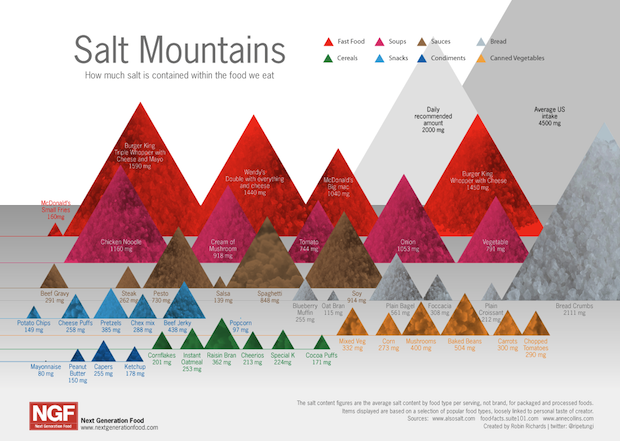
Infographic: The Mountains of Salt in Processed Food
You already know that salt intake is highly correlated with high blood pressure and heart disease. And you probably have a vague sense that processed foods contain a lot of salt. But the specifics are truly terrifying, as this graphic by Next Generation Food shows.
It's not exactly the most legible graph--I mean, triangles aren't exactly a case study in information clarity. But the point comes through. Check out, for example, that fact that a single Burger King Whopper with cheese has 75% of your recommended daily salt intake; and the fact that Americans eat 250% of their recommended daily allotment:
Labels:
Blood pressure,
clog,
Food,
Heart,
Salt
Subscribe to:
Posts (Atom)