Jul 20, 2011

Have you Ever Wondered How Alcoholic Drinks Look Like Under The Microscope?


    A company called Bevshots has produced a series of shots of booze under the microscope at the Florida State University's chemistry labs.(1000x magnification).


The process consist of letting a droplet of liquor dry out completely on a slide in an airtight container, and photographing the result with a 35mm camera. The entire process can take up to three months and as many as 200 attempts to properly capture the drink's constituent parts.

         Cocktails can have fruit and soft drinks in them which contain citric acids and complex sugars which dry out well and look great photographed.  The incredible shapes and colours of the boozy artwork are highlighted by shining natural light on top and through the bottom of the slide. Just like images of snowflakes, each drink is different.
These images are available for sale at Bevshots. Open for business since August 2009, Bevshots estimate that they have sold over 20,000 examples of their alcoholic. 

Sources:
http://twistedsifter.com/2010/06/alcoholic-art-liquor-under-a-microscope/
http://www.time.com/time/photogallery/0,29307,1999889_2157950,00.html
Enhanced by Zemanta

Jul 13, 2011

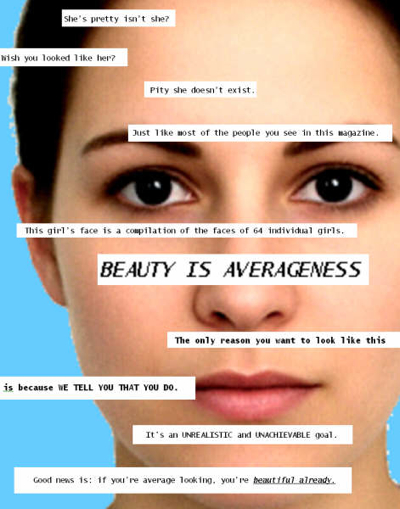
Killing Us Softly 3 : Advertising's Image of Women

"As timely and important as ever. . .A must for everyone who cares about media literacy and gender equity." -- Susan Douglas | author, Where the Girls Are: Growing Up With the Mass Media

    Jean Kilbourne continues her groundbreaking analysis of advertising's depiction of women in this most recent update of her pioneering Killing Us Softly series. In fascinating detail, Kilbourne decodes an array of print and television advertisements to reveal a pattern of disturbing and destructive gender stereotypes. Her analysis challenges us to consider the relationship between advertising and broader issues of culture, identity, sexism, and gender violence.

Includes a bonus 25-minute interview with Jean Kilbourne.

Sections:
Does the beauty ideal still tyrannize women? |
Does advertising still objectify women's bodies? |
Are the twin themes of liberation and weight control still linked? |
Is sexuality still presented as women's main concern? |
Are young girls still sexualized? |
Are grown women infantilized? |
Are images of male violence against women still used to sell products?

Jean Kilbourne

Jean Kilbourne is internationally recognized for her pioneering work on alcohol and tobacco advertising and the image of women in advertising. Her films, slide lectures and television appearances have been seen by millions of people throughout the world. She was named by The New York Times Magazine as one of the three most popular speakers on college campuses today.

Jul 8, 2011

Care of Transsexual Persons [Gender Identity Disorder ]

"A small but significant number of transsexual patients are seen every year in our service and in this journal we reported one such patient. We felt somewhat inadequately informed about the anatomy and postoperative care of our patient. We have thus reviewed the literature which we hope will help others in managing such patients." via  @wiki.ubc.ca


International classification of diseases (ICD) ICD 101 gives five diagnoses of gender identity disorders (GID) .
(1) Transsexualism .
This has three criteria: A desire to live and be accepted as a member of the opposite sex, usually accompanied by a sense of discomfort with, or inappropriateness of, one’s anatomic sex, and a wish to have surgery and hormonal treatment to make one’s body as congruent as possible with one’s preferred sex.The transsexual identity is present persistently for two years.
 The disorder is not a symptom of another mental disorder or a chromosomal abnormality.
(2) Dual role transvestism
(3) GID of childhood
(4) Other GIDs
(5) GID,  unspecified

According to the Diagnostic and Statistical Manual of Mental Disorders, 4th edition (DSM IV), a person must show strong persistant cross-gender identification (not merely a desire for any perceived cultural advantage of being the other sex) and a persistent discomfort with their sex or a sense of inappropriateness in the gender role of that sex, to be diagnosed with GID. The term transsexualism has been replaced with GID by DSM IV.

What is Rett Syndrome

What is Rett syndrome?

Rett syndrome is a disorder of brain development that occurs almost exclusively in girls. After 6 to 18 months of apparently normal development, girls with the classic form of Rett syndrome develop severe problems with language and communication, learning, coordination, and other brain functions. 
Early in childhood, affected girls lose purposeful use of their hands and begin making repeated hand wringing, washing, or clapping motions. They tend to grow more slowly than other children and have a small head size (microcephaly). 
Other signs and symptoms can include breathing abnormalities, seizures, an abnormal curvature of the spine (scoliosis), and sleep disturbances.
Researchers have described several variants of Rett syndrome with overlapping signs and symptoms. The atypical forms of this disorder range from a mild type, in which speech is preserved, to a very severe type that has no period of normal development. A form of Rett syndrome called the early-onset seizure variant has most of the characteristic features of classic Rett syndrome, but also causes seizures that begin in infancy.

Jun 8, 2011

Improving Posture and Ergonomics

 Human positions refers to the different positions that the human body can take.

There are several synonyms that refer to the human position, often used interchangeably, but having specific flavors.
  • Position is a general term for a configuration of the human body
  • Posture means the intentionally or habitually assumed position
  • Pose implies artistic or aesthetic intention of the position
  • Attitude refers to postures assumed for purpose of imitation, intentional or not, as well as in some standard collocations in reference to some distinguished types of posture: "Freud never assumed a fencer's attitude, yet almost all took him for a swordsman."
  • Bearing refers to the manner, of the posture, as well as of gestures and other aspects of the conduct.
      Over time, poor posture may be caused by habits from everyday activities such as :
-sitting in office chairs,
-looking at the computer,
-driving,
-standing for long periods of time,
-or even sleeping.
Related Posts Plugin for WordPress, Blogger...